
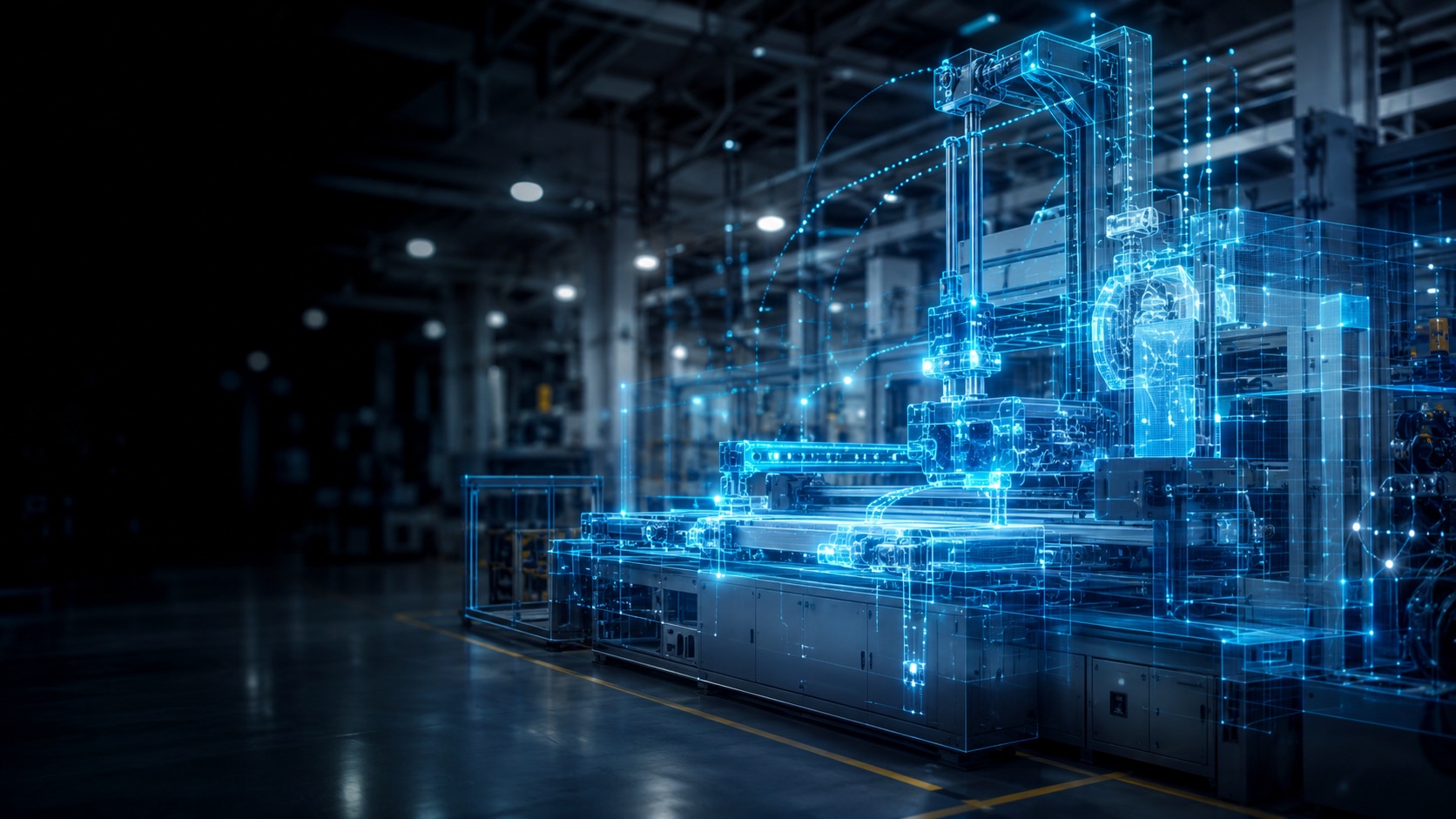
Every machine gets built twice. Once in software, where mistakes cost an afternoon — and once in steel, where they cost a shipment.
For most of industrial history the order was fixed: design it, build it, then find out on the shop floor what the drawings didn’t tell you. Commissioning — the frantic weeks of wiring, PLC edits, and sensor debugging that turn a pile of components into a working machine — happened last, under deadline, with the customer watching. It is where schedules go to die.
Virtual commissioning reverses the order. You build a physics-aware model of the machine — a digital twin — and connect it to the real control code before the physical machine exists. The PLC thinks it is driving a live line. In reality it is driving a simulation, and every fault it triggers is a fault you fix at a desk instead of on a crane.
Finding problems late is the expensive way to find them
The cost of a defect climbs by an order of magnitude at every stage it survives. A logic error caught in design review is a comment. The same error caught during on-site commissioning is a grounded crew, an idle assembly bay, and a customer whose line isn’t running yet.
Control software is where this bites hardest. A large share of commissioning time is spent debugging PLC logic — interlocks that fire in the wrong order, motion profiles that overshoot, edge cases nobody drew. None of that needs real hardware to surface. It only needs a model faithful enough to misbehave the way the real machine would.
If the controller can’t tell the simulation from the machine, then every bug the machine would have had is a bug you can fix today.
What a digital twin is actually made of
A useful twin isn’t a pretty 3D render — it’s an executable model with three layers working together:
- Mechanics & kinematics. Rigid bodies, joints, cams, and linkages with real mass and travel limits — so motion, collisions, and cycle times behave like the floor, not like an animation.
- Sensors & actuators. Every proximity switch, encoder, and valve emulated with the same signals the controller expects, wired to the same I/O map.
- The real control code. The actual PLC program — or the actual controller, hardware-in-the-loop — closing the loop against the model in real time.
Get those three right and the controller cannot tell it has been unplugged from reality. That is the whole trick, and it is why virtual commissioning catches the bugs a spreadsheet review never will.
Case study: four months instead of six
A special-purpose machine (SPM) builder came to us with a familiar squeeze: a fixed customer delivery date and a control system complex enough that on-site commissioning was the wild card in every estimate. We built a digital twin of the machine and ran the PLC program against it while fabrication was still underway.
By the time the physical machine was assembled, the control logic had already been exercised through its full cycle — start-up, fault recovery, e-stop, changeover — against a model that pushed back. On-site commissioning became verification, not discovery. The results were not marginal:
- 30% faster delivery — the project shipped in four months against a six-month baseline.
- ~20% lower development cost — rework and on-floor debugging hours were largely spent before the build, where they’re cheap.
- Two months of production handed back to the customer’s calendar.
Not every machine — but more than you’d think
Virtual commissioning earns its keep wherever control complexity, downtime cost, or delivery pressure is high. Across the sectors we work in, the pattern repeats:
Food & beverage and packaging lines live and die on changeover and throughput — both cheap to tune in simulation, brutal to tune on a running line. Pharmaceutical equipment carries validation burdens that reward a fully-exercised control system before qualification even starts. Industrial machinery and oil & gas skids often can’t afford a live test at all — the twin may be the only safe place to provoke a failure on purpose.
You don’t need to model everything
The mistake is treating the twin as a second full engineering project. It isn’t. The return comes from modeling the risky parts at the right fidelity — the subsystems where the controls are hard and the failure is costly — and stubbing the rest.
Our engineers typically start where you already have drawings and a control philosophy, build the twin in parallel with fabrication so it costs schedule nothing, and hand back not just a working machine but a reusable model your team keeps — for the next revision, the next operator training, the next line.
Precision, innovation, excellence — the tagline is easy. Shipping two months early is the version customers remember.
Ready to build your machine twice — and ship it once, early? Simulex Solutions provides product design, simulation, and virtual commissioning for food & beverage, packaging, pharmaceutical, industrial machinery, and oil & gas — engineered in India, supported around the clock. Start a project →